
Adult hormonal acne: why your creams are not enough
 Breakouts before your period ?
 Key takeaways
- Adult hormonal acne is concentrated mainly on the lower face (jaw, chin) and comes in flare-ups.
- Creams act on the superficial 0.2 mm; inflammation and scars form at a depth of about 1.5 mm.
- The effective approach: diagnosis first, then LaseMD laser and/or Genius RF + a suitable routine.
- Allow 3 to 4 sessions, with a result that keeps improving for 3 months.
You left your teenage years behind long ago, you've tried creams, serums, pharmacy routines — and the acne always comes back, often on the lower face. It's not a lack of hygiene or willpower: hormonal acne follows a different logic, and it is treated differently.
What is hormonal acne?
It's acne triggered or made worse by hormonal changes (cycle, stress, contraception, perimenopause). Androgens stimulate the sebaceous glands: sebum becomes thicker, pores clog, inflammation sets in. Unlike teenage acne, it appears or persists after age 25, and mostly affects women.
How to recognise it
A few characteristic signs:
- Located on the jaw, chin, neck and sometimes the lower cheeks.
- Deep, painful lesions (nodules, cysts) rather than simple blackheads.
- Cyclical flare-ups, often before your period.
- Red or brown marks that remain long after the spot.
Why creams eventually plateau
Most topical active ingredients — even the most serious ones — act on the first 0.2 millimetres of the skin. Yet hormonal inflammation and, above all, the scars it leaves form in the dermis, around 1.5 mm. A cream doesn't go that deep. It can maintain, smooth and prevent — but it doesn't rebuild a damaged dermis.
I don't sell sessions. I treat skin — and hormonal acne always starts with understanding where it comes from.
The House of Highline approach
Nothing begins without a skin diagnosis. We distinguish active acne (which we calm) from after-effects (which we erase), and build a precise protocol:
- LaseMD laser (1927 nm): micro-columns of heat at 1.5 mm to fade marks and texture and restart skin renewal.
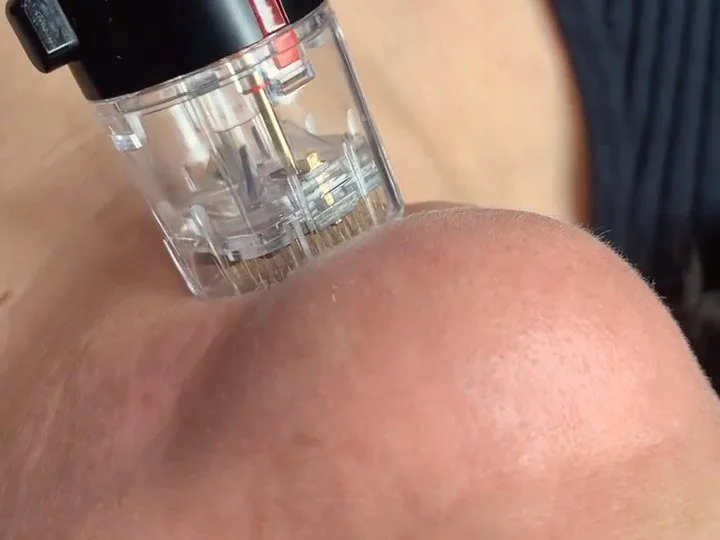
- Genius RF: micro-needle radiofrequency down to 2.5 mm to rebuild the dermis where acne has left hollows.
- Targeted routine at home, prescribed for your skin — not a standard kit.
| Approach | Depth of action | What it acts on |
|---|---|---|
| Cream / serum | ~0.2 mm (epidermis) | Maintenance, prevention, surface |
| LaseMD | ~1.5 mm (superficial dermis) | Marks, texture, radiance |
| Genius RF | ~2.5 mm (deep dermis) | Hollow scars, firmness |
How long before you see a result?
With the right protocol, active skin often calms down within the first weeks. For marks and scars, allow 3 to 4 sessions 4 to 6 weeks apart, with a result that keeps improving for about 3 months after the last session, while the collagen reorganises.
Limiting relapses
Hormonal acne doesn't "disappear" like flicking a switch: it is controlled. A suitable routine, daily sun protection (essential to stop marks from darkening) and regular follow-up keep the skin clear over time. If a clear hormonal cause is suspected, additional medical advice (dermatologist, gynaecologist) may be recommended in parallel.
Frequently asked questions
Can hormonal acne disappear for good?
You can't remove a hormonal predisposition, but you can control flare-ups for the long term and erase the after-effects. Regular follow-up maintains the result.
Is laser suitable when I still have active spots?
We adapt: on very inflamed skin, we calm it first, then treat texture and marks. The diagnosis sets the right order.
Does it work on dark skin?
Yes, with a prior assessment and adapted settings. That's exactly why we never treat without a diagnosis.
How many sessions should I plan for?
Generally 3 to 4 sessions 4 to 6 weeks apart for marks and scars, sometimes fewer for a simple radiance boost.
Is the treatment painful?
An anaesthetic cream is applied before laser or Genius RF sessions. The sensation remains entirely bearable.
Should I stop my current routine?
Not necessarily — we assess it during the diagnosis and adjust it rather than sweeping it all away. Some products will be kept, others replaced.